Wednesday, 16 August 2023

Bioplastics Industry To Develop As Of Rising Concern Regarding Plastic Waste All Over The Globe


Bioplastics Industry Data Book Covers Biodegradable Plastic, Polylactic Acid (PLA), Bio-based Polyurethane (PU) and Biopharma Plastics Markets.


The economic volume generated by the bioplastics industry was estimated at approximately 2,470.6 kilotons in 2021.


Access the Global Bioplastics Industry Data Book, 2022 to 2030, compiled with details like market sizing information & forecasts, trade data, pricing intelligence, competitive benchmarking, macro-environmental analyses, and regulatory & technological framework studies.


Biodegradable Plastics Market Growth & Trends


The global biodegradable plastics market size is projected to reach USD 10.0 billion by 2030, according to a report by Grand View Research, Inc., rising at a CAGR of 9.7% during the forecast period. The increasing use of biodegradable plastics, owing to strict governmental laws prohibiting the use of conventional plastics, coupled with growing awareness among the public towards the ill effects of plastic waste is stoking the growth of the market. The above factors are expected to spur market growth during the forecast period.


Biodegradable plastics are plastics that decompose in the environment within a reasonable period. Biodegradable plastics are made up of renewable raw materials. Many of these plastics require biodegradable additives to enhance the biodegradation process and some may require a specific environment to disintegrate. Time taken by plastics to decompose depends upon various factors such as raw materials used and environmental conditions such as moisture and temperature.


The starch-based segment leads the global market. Starch-based plastics are used in various applications such as packaging, consumer electronics, agriculture, automotive, and textiles. PLA is also one of the most consumed biodegradable plastic-type. It is used in 3D printing, mulch film, and packaging.


Polylactic Acid Market Growth & Trends


The global polylactic acid market size is expected to reach USD 2,772.93 million by 2030, registering a CAGR of 21.4% over the forecast period, according to a new study by Grand View Research, Inc. Rising environmental concerns, improving awareness among consumers, and stringent government regulations are contributing to eliminating the use of non-biodegradable plastics, which, in turn, is driving the growth of the polylactic acid (PLA) market. Polylactic acids are bio-sourced, and break down faster as compared to petroleum-based plastics. Due to their decreased carbon footprint, they get preference over traditional plastics. The rising emphasis on sustainable products is a key factor driving the growth of the flexible packaging industry, which is expected to result in reduced consumption of petroleum-based products and a shift toward bio-based alternatives.


Order your copy of Free Sample of “Bioplastics Industry Data Book - Biodegradable Plastic, Polylactic Acid (PLA), Bio-based Polyurethane (PU) and Biopharma Plastics Market Size, Share, Trends Analysis, And Segment Forecasts, 2022 - 2030, published by Grand View Research


Bio-based Polyurethane Market Growth & Trends


The global bio-based polyurethane market size is expected to reach USD 58.28 million by 2030, expanding at 7.97% CAGR from 2023 to 2030, according to a new study by Grand View Research, Inc. Growing awareness among consumers, environmental concerns, and stringent government regulations are contributing to the increased use of bio-based plastics and in turn, driving the growth of the bio-based polyurethane industry.


Bio-based polyurethane is bio-sourced and breaks down faster as compared to petroleum-based plastics. Due to their decreased carbon footprint, they remain a preferred option over traditional plastics. The rising emphasis on sustainable products is a key factor driving the growth of the packaging industry, which is expected to result in reduced consumption of petroleum-based products and a shift toward bio-based alternatives.


Moreover, bio-based polyurethane is increasingly being used to manufacture single-use packaging materials that include shopping bags and disposable cutlery, which is likely to boost their demand over the forecast period. Bio-based polyurethane is an environmentally friendly alternative to traditional plastics, notably in flexible and rigid packaging applications, as they are bio-based, compostable, and biodegradable.


Biopharma Plastics Market Growth & Trends


The global biopharma plastics market size is expected to reach USD 11,290.12 million by 2030, expanding at 11.3% CAGR from 2023 to 2030, according to a new study by Grand View Research, Inc. The rise in global healthcare expenditure for research & development of biopharma plastics is anticipated to drive the market. In addition, the rising demand for biopharmaceuticals, owing to the increasing cases of cancerous patients across the globe, is anticipated to propel the demand for biopharma plastics.


Plastics are widely used in this industry due to their versatility, durability, and cost-effectiveness. The use of plastics in biopharma applications includes packaging and delivery systems, laboratory equipment, diagnostic devices, and drug delivery devices.


The global biopharma plastics industry is expected to experience significant growth in the coming years. This growth is driven by factors such as the increasing demand for biopharmaceuticals, the growing prevalence of chronic diseases, and the rise in healthcare expenditure. Additionally, the need for more advanced and innovative packaging and delivery systems for biopharmaceuticals is also expected to drive market growth.


Go through the table of content of Bioplastics Industry Data Book to get a better understanding of the Coverage & Scope of the study.


Competitive Landscape


Key players operating in the Bioplastics Industry are –


• BASF SE
• Avantium
• NatureWorks LLC
• SABIC
• Total Corbion PLA
• Biome Technologies plc
• TEIJIN LIMITED


Grand View Research’s Bioplastics industry data book is a collection of market sizing information & forecasts, regulatory data, competitive benchmarking analyses, macro-environmental analyses, and technological framework studies. Within the purview of the database, all such information is systematically analyzed and provided in the form of presentations and detailed outlook reports on individual areas of research.

Monday, 5 December 2022

Solar Energy Generation Industry ESG Thematic Report, 2022

 Solar Energy Generation Industry ESG Thematic Report, 2022


The average ESG score for the solar energy generation industry is between 55% and 65%. Our proprietary ESG scoring framework analyzed 65 parameters across the environment, social, and corporate governance, as represented in the methodology section of this document.


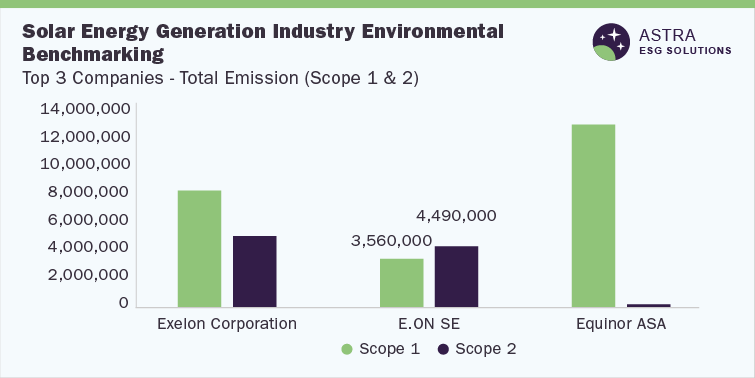
E.ON SE, Exelon Corporation, and five other market leaders were part of our research. Four of the market leaders ranked above average industry scores. However, one company needs to focus more on ESG reporting and transparency, as it scored well below the industry average. The majority of sustainability-related disclosures are centered on governance metrics, followed by environmental and social disclosures. E.ON SE leads the sector in terms of ESG disclosure, followed by Exelon Corporation and Equinor ASA.


For More Details: https://astra.grandviewresearch.com/solar-energy-generation-industry-esg-outlook


Environmental insights


Solar energy is one of the most impactful renewable energy sources that have significant potential in driving the energy transition. For example, solar panels can be used to generate clean power at home and reduce the cost of electricity in the long term. Solar panels are also a boon to the environment, as they reduce pollution. A well-built solar system within the premises can also help charge electric cars. Greater use of solar energy can, therefore, lower the need for nonrenewable fossil fuel sources, such as coal, natural gas, and so on. The use of solar power will have an immediate, measurable impact on the environment and provide a good Return on Investment (ROI).


Social insights


Solar energy generation companies have emphasized various social aspects such as turnover rate, health & safety, diversity, enterprise & employee/customer communications through surveys, and human rights alignment. These areas are essentially the foundation of a company’s social pillar. Our research found that ESG disclosure around social pillars has not been significant, and it has scope for improvement. With respect to social disclosure, E.ON SE leads the way, followed by Duke Energy Corporation and Exelon Corporation.


Our assessment showed that all major companies within the sector have conducted comprehensive employee and customer satisfaction surveys. Surveys like these provide organizations with insights into areas that need improvement. The companies have ingrained proper human rights practices within their operations along with the supply chain, and their code of conduct is aligned with global human rights standards.


Governance insights


According to our research, the average industry governance score is 71%, which is the highest among all the ESG pillars. The governance pillar included information on female board members, independent directors, compensation linked to ESG parameters, and clawback policy, among others. The industry leaders scored well above 75% in the corporate governance pillar, with Exelon Corporation scoring the highest, followed by E.ON SE and Duke Energy Corporation.


The corporate governance structure becomes robust with more independent representation on the board. Our research showed that 100% of E.ON SE's directors were Independent directors, while Exelon Corporation had the lowest percentage of independent directors. An inclusive board structure demonstrates the company's commitment to diversity as well. Exelon Corporation had the highest percentage of females on its board at 33.33% followed by the others.


Request for Free Demo: https://astra.grandviewresearch.com/solar-energy-generation-industry-esg-outlook/request/rs1


Monday, 3 October 2022

Solid State Battery Industry ESG Thematic Report, 2022


Solid State Battery Industry ESG


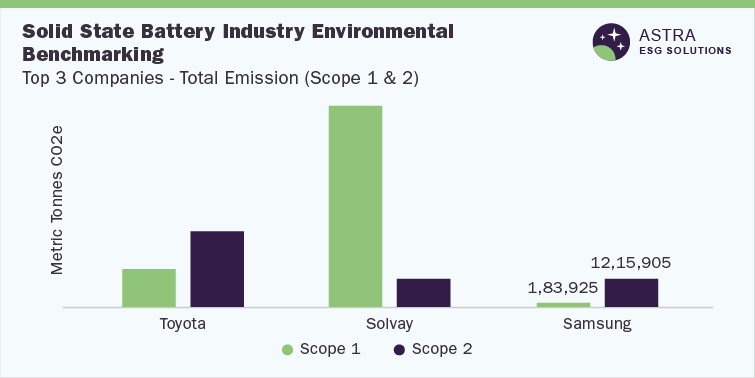
The average ESG disclosure score for the solid state battery industry is between 60% and 70%. Our proprietary Environment, Social, & Corporate Governance (ESG) scoring framework analyzed 65 parameters across ESG, as represented in the methodology section of this document.


Toyota Motor Corporation, Solvay SA, and two more market leaders were part of our research. Three out of four companies we researched scored above the average industry score. However, one of the market leaders needs to focus more on ESG reporting and transparency as it scored well below 60%.


For More Details: https://astra.grandviewresearch.com/solid-state-battery-industry-esg-outlook


Environmental insights

Batteries play an important role in our lives, from providing the initial power needed to start engines of cars to act as a backup source of electricity in telecommunications, public transportation, and medical procedures. Improperly disposed batteries negatively affect human health and also contribute to water and air pollution, affecting the environment, as they contain strong corrosive acids & chemicals. A solid-state battery, as the name suggests, uses solid electrodes and a solid electrolyte instead of liquid or polymer gel electrolytes found in lithium-ion or lithium polymer batteries. They have many advantages over other battery types. Energy efficiency, compactness, lightweight, and higher running range are some of the key advantages compared to the current lithium-ion batteries. In addition, they also do not pose the risk of explosion or there is a lower risk of battery fire; hence, there is no need to have safety components, which saves more space.


Social insights

Social metrics are an assessment of the risks that a firm may face from both human capital and the community. The variables that are accounted for in this classification include how an organization manages its relations with its workers, financial investors, the communities in which it operates, and the political environment. Within this category, for the solid state battery industry, Samsung SDI has topped among its peers with a score of∼70%. They have a standardized Supplier Code of Conduct which has various rules and regulations inclusive of human rights and diversity. The company has also obtained ISO 45001 certification for Industrial Safety and Health Management System as compared to Toyota Motor Corporation, which has only eight global plants that have acquiredISO 45001 certifications.


Governance insights

The governance component within ESG evaluation measures factors involved in policy-making, such as board structure, distribution of rules & regulations along with details of the responsibilities among stakeholders, employees, suppliers, and top executives. As per Grand View Research’s ESG scoring model, Solvay SA ranks the highest in corporate governance among its competitors, with a score of ∼70%, functioning within the solid state battery industry. The organization has the highest number of independent directors (more than 70% of the board includes independent directors), while the female representation on the board is also seen to be highest with a score of 26.67%. Furthermore, Solvay SA also has a clawback policy in place, which enables it to reclaim Performance Share Units (PSU) for a period of 3 years from the date of the payment with regards to its executives.

With an increase in the cases of cyberattacks, Toyota Motor Corporation established the All Toyota Security Guidelines (ATSG), based on ISO 27001/27002; US National Institute of Standards and Technology (NIST) - Cybersecurity Framework; and Cybersecurity Management Guidelines by the Ministry of Economy, Trade, and Industry, which ensure information security through a multifaceted approach: through organization, human resources, technical security, physical security, and incident/accident response. The organization also has external and internal hotlines integrated into the “Speak up” Hotline, which allows anonymous reporting and is open to third parties, including family members of an interested party.


Request for Free Demo: https://astra.grandviewresearch.com/solid-state-battery-industry-esg-outlook/request/rs1


Friday, 30 September 2022

Solar Inverter Industry ESG Thematic Report, 2022

 Solar Inverter Industry ESG Thematic Report


The average ESG disclosure score for the solar inverter industry is between 60% and 70%. Our proprietary ESG scoring framework analyzed 65 parameters across the environment, social, and corporate governance, as represented in the methodology section of this document.


Siemens AG, Eaton Corporation, Delta Electronics, and three more market leaders were part of our research. Only half of the six companies we researched scored above the average industry score. However, the bottom-ranked among market leaders need to focus more on ESG reporting and transparency, as they scored very poorly on multiple aspects.


For more details: https://astra.grandviewresearch.com/solar-inverter-industry-esg-outlook


Environmental insights


The majority of the energy market is still held by conventional sources like natural gas, oil, coal, or nuclear. However, with growing energy demand, the world is increasingly adopting renewable energy sources that are sustainable. PV inverter plays the crucial role of inverting the current collected by the solar panels (Direct Current [DC]) to the energy that can be used inside our homes (AC). Hence, it is an inevitable part of the solar power generation system. Although pollution during the operational lifecycle of a photovoltaic system is minimal, the environmental impacts during manufacturing and disposal cannot be ignored.


The major players in the photovoltaic inverter industry have revised their environmental commitments and improved transparency. This is evident from their efforts to reduce carbon emissions, promoting ISO 14001 certifications and TCFD mechanisms. There are new programs being implemented by these companies to achieve their emissions targets, increase water efficiency, and reduce waste. Some of these companies have committees exclusively to monitor how the company is performing on the sustainability front. In Delta Electronics Inc, the ESG committee is chaired by Chief Sustainability Officer. In OMRON Corporation, the sustainability committee is overseen by the Board of Directors. At Eaton Corporation Plc, the sustainability executive council comprises Chairman and Chief Operating Officer. Among companies within the sector, Delta, OMRON, and Eaton rank highest on environmental parameters with a score above 80%.


Social insights


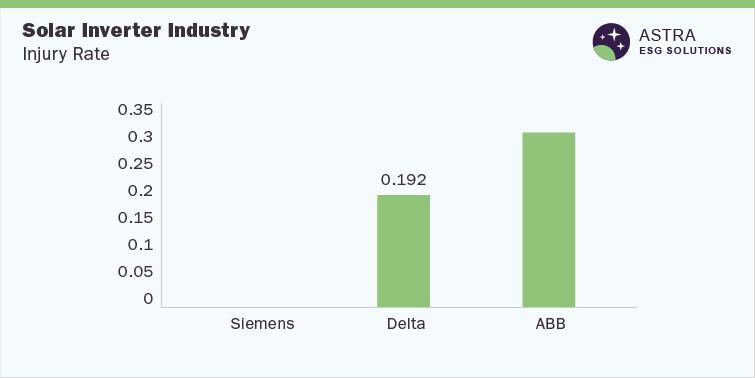
Social metrics assess risks that a firm may face from both human capital and the community. The parameters used for assessment include, but are not limited to, turnover rate, injury rate, employee engagement programs, training & development, health & safety certifications, and community development. On the basis of the above parameters, companies have been ranked, and Delta Electronics secured the top rank in overall social performance with a score of little less than 80%, followed by Siemens AG and ABB.


Governance insights


One of the most significant foundation stones of a firm is its governance, which encompasses a variety of criteria such as corporate ethics, board structure, financial transparency, and anti-corruption, among others. After the assessment of governance among major companies in the solar inverter industry, Siemens fetched the top rank with an above 90% score. Other top performers were Eaton Corporation and Emerson Electric. The Siemens Integrity Initiative, which combats corruption and fraud via collective action, education, & training, adheres to the highest compliance and anti-corruption standards as well as promotes integrity. Siemen’s executive pay includes performance criteria related to sustainability metrics.


Country-level insights


The demand for energy is increasing every year, which is driving the need for various renewables, such as solar energy. The increasing need for a steady power supply in harsh climatic conditions or remote locations has led to the enhanced deployment of off-grid solar PV systems, thereby propelling the PV inverter product demand. In addition, favorable government policies and initiatives regarding clean fuel usage are expected to further amplify PV Inverter industry growth. The following section looks into various initiatives around the globe with regard to promoting the solar PV market.


Request for Free Demo: https://astra.grandviewresearch.com/solar-inverter-industry-esg-outlook/request/rs1


Wednesday, 28 September 2022

Hydrogen Generation Industry ESG Thematic Report, 2022


Hydrogen Generation Industry ESG


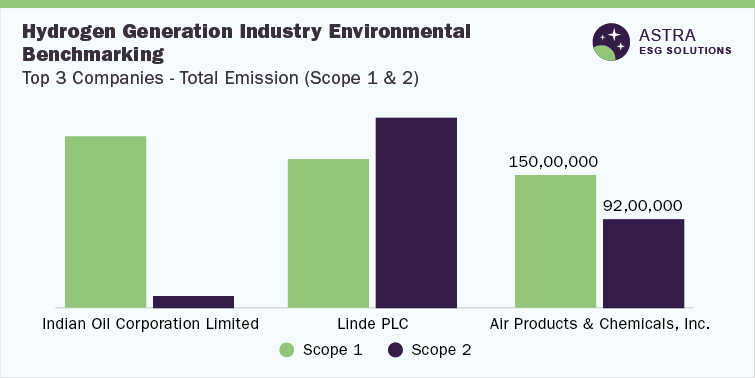
The average ESG disclosure score for the hydrogen generation market stands between 40% and 50%. This conclusion is based on the analysis of more than 60 Environment, Social, & Corporate Governance (ESG) parameters within our ESG scoring framework. Alongside Linde PLC and Indian Oil Corporation, six other market leaders were part of our research. This research identified that only four companies, including Indian Oil Corporation and Linde PLC, scored above the average industry score while the four other leading companies are required to improve their ESG transparency & reporting, as they scored well below 40%. Our research found that majority of the ESG disclosures have been made around the governance metric, with Linde PLC being a leader in this sector when compared to other companies, such as Bloom Energy Corp & Air Liquide, from an overall ESG disclosure point of view.


For More Details: https://astra.grandviewresearch.com/hydrogen-generation-industry-esg-outlook


Environmental insights

Since 1975, there has been a threefold increase in demand for hydrogen. However, its production poses significant consequences for the environment, as it is almost entirely derived from fossil fuels and around 800 million tons of CO2 equivalent emissions are released annually in hydrogen production. The enormity of hydrogen production is such that around 6% of natural gas produced globally goes into producing hydrogen.


Social insights

Within the social component of ESG, improvements around the value chain of a firm, increase in employee engagement & retention, and the method of promoting business continuity are mainly measured. Around seven out of eight companies, i.e., 87.5% of the companies in the industry, have a Human Rights Policy integrated in their supply chain. However, barring some industry leaders, such as Linde PLC and Indian Oil Corporation, none of the other companies have a supplier code of conduct. This outlines opportunities for improvement in terms of value chain operations among other competitors in the industry. Few companies like Bloom Energy Corporation, despite having lower social score, have a publicly available business partner/supply chain policy and furthermore conduct supply chain audits. Similarly, other companies require audits in place to follow due diligence regarding supplier code of conduct.


Governance insights

Financial outperformance is long discussed to have a strong relationship with ESG metrics; however, the governance factor is identified to have a more substantial impact on this factor (financial outperformance), based on empirical evidence. Governance metrics affecting valuation of corporate businesses are corporate governance, code of business conduct, risk & crisis management, tax strategy, supply chain management, and policy influence & materiality.

The industry leaders in social benchmarking are Air Products and Chemicals Inc., with around 80% governance score, followed by Air Liquide, which has a score well above 70%. However, in terms of female representation, Air Liquide has the highest proportion of female on board, at more than 50%, which is higher than the industry leaders Air Products and Chemicals Inc.


Request for Free Demo: https://astra.grandviewresearch.com/hydrogen-generation-industry-esg-outlook/request/rs1


Thursday, 15 September 2022

Solid Oxide Fuel Cell Market To Create Business Opportunities, Based On Increasing Private-Public Partnerships


Solid Oxide Fuel Cell Market


Solid Oxide Fuel Cell Industry Overview


The global solid oxide fuel cell market size is expected to reach USD 7,124.4 million by 2030, registering a CAGR of 40.7% during the forecast period, according to a new report by Grand View Research, Inc. Growing expenditure on infrastructure and industry development is expected to have a positive impact on the global market in the forecast period.


Installers and system providers usually hold stock of significant equipment in the inventory. However, manufacturers face bottlenecks and shortages due to the limited production in countries, severely affected by the COVID-19. Further, upcoming Solid oxide fuel cells (SOFC) based large-scale projects are expected to witness delays in commissioning due to the disruptions in supply chain and halting of on-site construction activities.


Solid Oxide Fuel Cell Market Segmentation

Grand View Research has segmented the global solid oxide fuel cell market based on application and region:


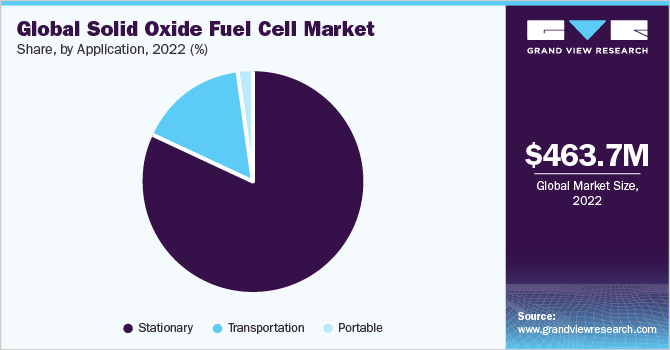
Based on the Application Insights, the market is segmented into Transportation, Portable, Stationary.

  • The stationary application segment led the market and accounted for 81.35% revenue share in 2021. A stationary solid oxide fuel cell system is one of the cleanest and most efficient heat and electricity generation technologies. The performance of these systems is focused on three high-level parameters, including net electrical efficiency, overall efficiency in the case of cogeneration, and durability.
  • European countries such as France and the UK are investing heavily in the R&D of solid oxide fuel cells for power generation and transportation applications. The factors above are expected to boost the growth of the stationary application segment in the SOFC market throughout the forecast period.
  • Collaboration among SOFC vendors and transportation sector vendors is expected to develop SOFC-based systems for transportation applications during the forecast period.
  • For instance, in December 2020, AVL and Ceres signed a strategic collaboration for fuel cell development in order to accelerate product development of SOFC technology across stationary, transportation, and various other applications.
  • With this collaboration, both companies will use a combination of their intellectual property portfolios of solid oxide fuel cell systems to offer new solutions to their clients.


Solid Oxide Fuel Cell Regional Outlook

  • North America
  • Europe
  • Asia Pacific
  • Rest of World


Key Companies Profile & Market Share Insights

In recent years, commercialization of SOFC systems has started with specific niche markets, such as small-scale combined heat and power (CHP) in Japan, and on-site power generations, especially for data centers and military applications in the U.S. Majority of the market participants have focused their research and development activities to develop SOFCs for multiple applications. As a result, the market has witnessed a number of public-private partnerships.


Some prominent players in the global solid oxide fuel cell market include

  • Bloom Energy
  • Mitsubishi Power Ltd.
  • Cummins Inc.
  • Ceres
  • General Electric
  • Fuel Cell Energy Inc.
  • Ningbo SOFCMAN Energy
  • KYOCERA Corporation
  • AVL
  • NGK SPARK PLUG CO., LTD.


Order a free sample PDF of the Solid Oxide Fuel Cell Market Intelligence Study, published by Grand View Research.


About Grand View Research

Grand View Research, U.S.-based market research and consulting company, provides syndicated as well as customized research reports and consulting services. Registered in California and headquartered in San Francisco, the company comprises over 425 analysts and consultants, adding more than 1200 market research reports to its vast database each year. These reports offer in-depth analysis on 46 industries across 25 major countries worldwide. With the help of an interactive market intelligence platform, Grand View Research Helps Fortune 500 companies and renowned academic institutes understand the global and regional business environment and gauge the opportunities that lie ahead.

Wednesday, 14 September 2022

Organic Rankine Cycle Market To Predict Global Expansion, Due To Rise In The Adoption Of Renewable Energy


Organic Rankine Cycle Market


Organic Rankine Cycle Industry Overview


The global organic rankine cycle market size is expected to reach USD 1.07 billion by 2030, according to a new report by Grand View Research, Inc. The market is expected to expand at a CAGR of 3.3% from 2022 to 2030. A rise in the adoption of renewable energy in countries such as the U.S., China, Germany, and Canada is making supporting regulations and providing financial incentives for the deployment of renewable energy. Financial incentives such as feed-in-tariff, subsidies, and tax benefits are some of the major tools utilized by countries around the world to attract investment in the renewable energy sector. These factors propel the growth of the organic rankine cycle (ORC) market in the near future.


The supply chains of spare parts for ORC systems are majorly affected due to the shutdown of production facilities of the manufacturers. The manufacturing of most components in the energy & power sector is slowing down considerably. In addition, local and international travel restrictions, quarantine requirements, and lockdowns have caused delays in shipments of already manufactured parts to be supplied to the distributors and end-users. ORC manufacturers usually have access to an adequate supply of critical parts, devices, components, and materials for emergencies.


Organic Rankine Cycle Market Segmentation

Grand View Research has segmented the global Organic Rankine Cycle (ORC) market based on application and region:


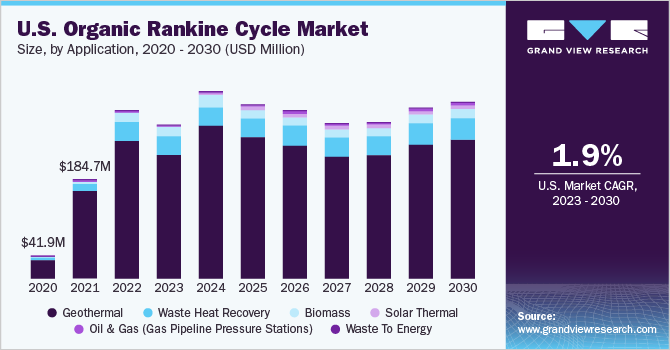
Based on the Application Insights, the market is segmented into Waste Heat Recovery, Biomass, Geothermal, Solar Thermal, Oil & Gas (Gas pipeline pressure stations), Waste to Energy.

  • The geothermal segment led the market and accounted for the largest revenue share of 61.71% in 2021.
  • The major reason for the dominance of the geothermal segment is due to the large-scale megawatt capacity of these geothermal projects as compared to other application segments such as biomass, waste heat recovery, and solar thermal.
  • Countries with high geothermal potential such as the U.S., Turkey, Kenya, New Zealand, and Indonesia have taken significant steps to utilize the available geothermal potential available in their respective countries. For instance, from 2017 to 2018 Indonesia started the commercial operation of geothermal power plants with a cumulative capacity of 330 MW.


Organic Rankine Cycle Regional Outlook

  • North America
  • Europe
  • Asia Pacific
  • Central & South America
  • Middle East & Africa (MEA)


Key Companies Profile & Market Share Insights

The key players operating in the market are Ormat, Turboden, and Exergy, along with a few medium and small regional players. Leading market players compete based on their product development capabilities and new technologies used in product formulations.


Some prominent players in the global organic rankine cycle market include

  • Elvosolar, a.s
  • Enogia SAS
  • Exergy S.p.A.
  • General Electric
  • INTEC GMK
  • Ormat
  • TAS
  • Triogen
  • Turboden S.p.A.
  • Zhejiang Kaishan Compressor Co., Ltd.


Order a free sample PDF of the Organic Rankine Cycle Market Intelligence Study, published by Grand View Research.


About Grand View Research

Grand View Research, U.S.-based market research and consulting company, provides syndicated as well as customized research reports and consulting services. Registered in California and headquartered in San Francisco, the company comprises over 425 analysts and consultants, adding more than 1200 market research reports to its vast database each year. These reports offer in-depth analysis on 46 industries across 25 major countries worldwide. With the help of an interactive market intelligence platform, Grand View Research Helps Fortune 500 companies and renowned academic institutes understand the global and regional business environment and gauge the opportunities that lie ahead.